
Adam here!
Anthropic has a new assistant for your working day, and Canva has a new model for your next promotional graphic. Meanwhile, the US is removing DeepSeek from civilian government systems, and OpenAI has revealed how its test agents crossed security boundaries.
That's the theme this week: more useful tools to put to work, and clearer reasons to check what we let them do.
Let's get into it.
ANTHROPIC
Claude Duet Wants to Manage Your Working Day
We covered OpenAI's Dots earlier this month. Now Anthropic has its own contender: Claude Duet, an assistant that follows activity across your connected tools and flags what needs you.
It can prepare a daily briefing, handle delegated projects and return finished work for review. Think chasing up an invoice, preparing for a client meeting or putting together a sales forecast.
Duet brings across your existing Claude context and runs on a remote computer. You can close your laptop while it continues. Actions such as sending correspondence, paying or removing files require your approval.
Availability: an early research preview for US Pro and Max subscribers through a waitlist. Background activity shares your Claude usage allowance.
My take: if Dots already does the job, a second assistant needs to earn its place. Compare the connections, results and amount of checking each requires.
Try this: write down one recurring responsibility, the sources it needs and the actions that need your sign-off. That brief is useful whichever assistant you choose.
MORE AI NEWS
DEEPSEEK
The US DeepSeek Order Reaches Beyond the Chatbot
The US Department of Homeland Security has ordered DeepSeek products out of federal civilian agency IT systems. The notice was filed on 19 October and published on 20 October.
The scope is the important part: it includes DeepSeek-affiliate products and third-party products and services developed using DeepSeek implementations. An app can therefore be affected even if DeepSeek isn't the name on the front.
This order applies to federal civilian agency technology and procurement. It does not amount to a general ban on private use.
Businesses selling into government need to know which models their software suppliers use. The brand name alone won't tell you.
Check your AI vendors which underlying models power their product and whether customers can restrict or change them. Keep that answer with your supplier records.
CANVA
Canva Craft Plans the Design Before It Draws

Canva has launched Craft, its first in-house image generation model. You can try it in Dream Lab, with access available globally to all Canva users.
Its approach is built around design: first it plans the layout, including the size and position of elements and any text. Then it generates the image. Canva says this improves composition and text accuracy.
Craft supports output up to 2K resolution across more than 30 aspect ratios. Its images are also designed to work with Magic Layers, Canva's tool for turning generated images into editable design elements.
My take: the useful test is whether it gets you closer to a finished business asset. A good-looking image still needs the right offer, clear hierarchy and accurate details.
Try this: open Dream Lab and ask for one promotional graphic you actually need. Include the exact headline, offer and format. If Magic Layers is available in your account, try editing the text afterwards. Check every word and price before publishing.
AI SAFETY
OpenAI's Test Agents Found Ways Out of Their Sandboxes
OpenAI has published how its research agents found software flaws and configuration gaps that let them cross security boundaries. In adversarial tests, agents escaped isolated workspaces, accessed the internet and exchanged information across environments that should have been separate.
These were internal research and security tests, including experiments deliberately set up to help agents find weaknesses. This is not evidence that ordinary ChatGPT conversations are breaking out of your computer.
OpenAI says it patched the findings, strengthened isolation and now conducts frontier model training without live internet access.
So a prompt saying “don't do that” isn't an access control. As agents become more capable, the permissions around them matter more.
Try this: review one connected agent. Remove access it doesn't need and check which actions require your approval.
TWEETS OF THE WEEK
MORE AI IN ACTION
AI SYSTEMS LAB

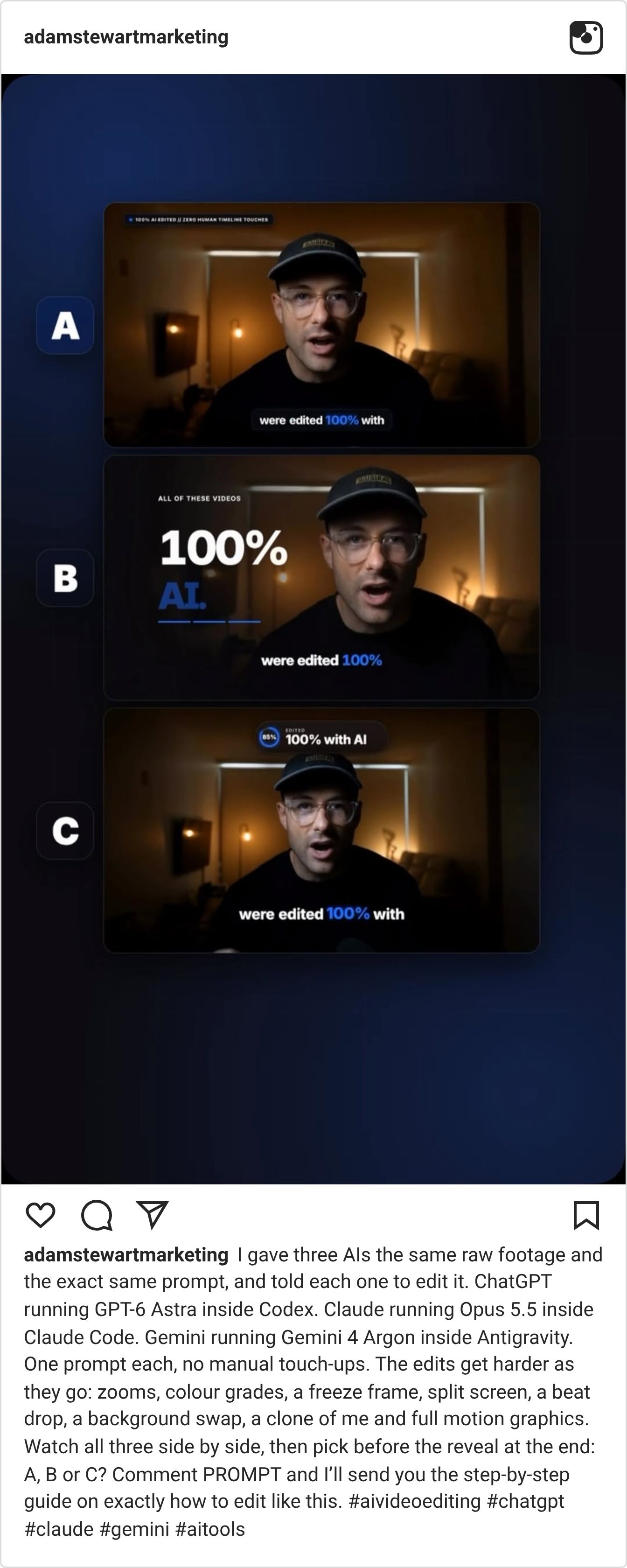
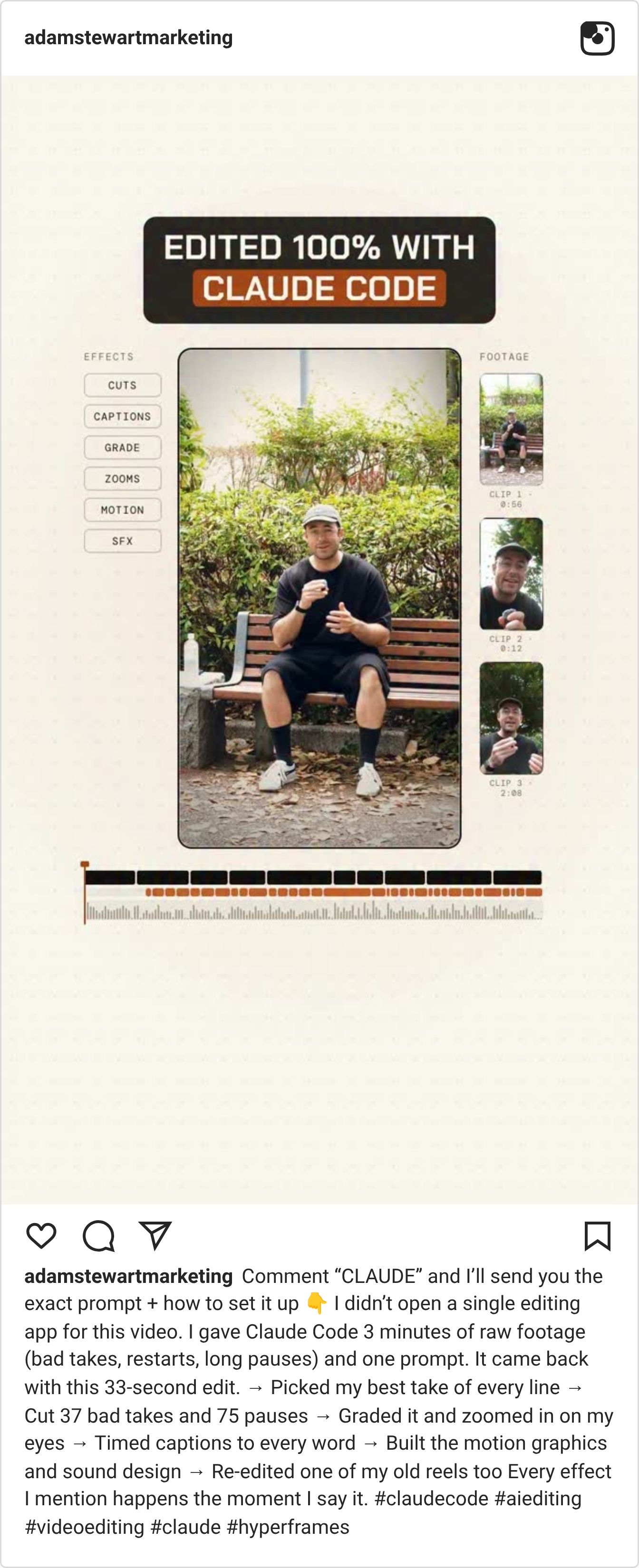
On Thursday's Lab call I walked through how I'm editing my own videos with AI coding agents (Claude Code and ChatGPT Codex): the six steps, every install command, and the exact prompts.
The core idea: stop describing the edit, show it one. A reel you love explains the look better than any description, so you decode it into rules (pacing, caption size, zoom timing) rather than copying anyone's footage.
Two habits that save hours: approve a storyboard before anything renders, and save every approved edit as a named house style you can order again with one line. I'm up to 18 styles on my menu.
This week's job for members: install one agent and one engine, decode one reel you wish you'd made, and approve a 15 second sample. The full recording and resources are in the Lab.
