Adam here!
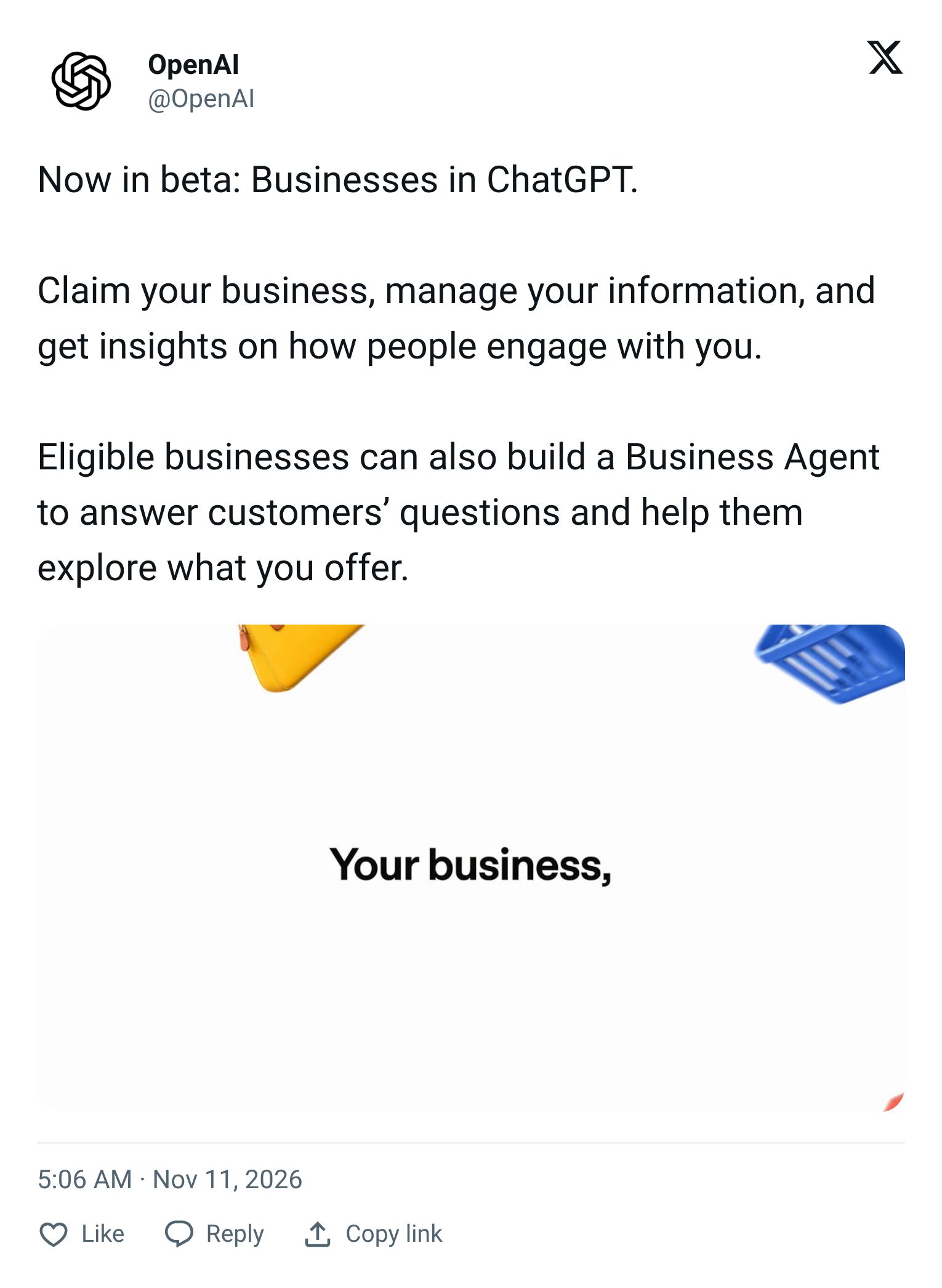
You can now claim your business in ChatGPT and see how often it comes up when people are researching what you sell.
Meanwhile, Claude can start drafting a plan while your meeting is still happening, ChatGPT Wallet lets eligible US users approve purchases by their dots, and Google has introduced Gemini 4 Hydrogen for faster everyday work.
Here’s what’s available, what’s still rolling out, and what’s worth trying.
OPENAI
ChatGPT Now Lets You Claim Your Business

OpenAI launched Businesses in ChatGPT in beta on 10 November. Through Business Hub, eligible businesses can claim their organisation and, once verified, update key details and add product feeds with current pricing and availability.
You also get aggregated insights: how often your business is mentioned, website clicks and common discovery topics in conversations where your site is cited. OpenAI doesn't share people's conversations with businesses.
Claiming and Business Agents have different eligibility. Eligible businesses where ChatGPT is available can claim their business. Business Agents, which answer customer questions using your information, initially cover eligible US ecommerce and online service businesses.
Those agent conversations are clearly labelled and separate from ChatGPT's independent answers.
My take: this is worth checking if customers already use AI to research what you sell. Accurate information is useful; claiming a profile doesn't guarantee a recommendation.
Try this: ask ChatGPT for businesses offering your service in your area. Check whether your name, website and offering are accurate, then review your eligibility in Business Hub.
MORE AI NEWS
ANTHROPIC
Claude Can Start the Work Before Your Meeting Ends

Anthropic announced Claude Meetings on 12 November. Claude joins a video call as a visible participant, follows the discussion and helps produce work while the team is still talking.
Ask it to start a planning document, put a timeline on a whiteboard or answer a question using connected tools with permission. Teammates can refine the artifacts during the call. Notes, action items and the work it built are kept on the meeting's page afterwards.
Availability: rolling out in beta on Team and Enterprise plans, starting with Google Meet. Enterprise admins need to enable it, and some workspace configurations aren't supported during the beta.
Claude posts a notice when it joins and saves a transcript, summary and screen descriptions rather than audio. Everyone should agree to being transcribed before you add it.
My take: a recap is useful. Leaving a meeting with a draft plan already taking shape is the more interesting change.
Try this: start with an internal planning call and ask for a document listing decisions, owners and unresolved questions. Review it together before assigning the work.
OPENAI
ChatGPT Wallet Lets Your Dot Pay After You Approve

OpenAI introduced ChatGPT Wallet on 13 November, giving agents a way to complete purchases without seeing your actual card details.
Add an eligible card once. Before each purchase, you review the items, total and selected card, then approve with a security check such as Face ID or a fingerprint scan. The payment network supplies a token in place of your real card details.
Initial rollout: through Dots for ChatGPT Pro subscribers aged 18 and over in the US, using eligible US-issued cards. It isn't broadly available in Australia.
Fully delegated purchasing within spending rules is a future plan. Today's version requires approval for each purchase.
My take: for retailers, the question is whether a legitimate customer using an agent can actually get through checkout. Payment and fraud systems may still reject these transactions.
Practical takeaway: ask your ecommerce and payments providers how they identify agent purchases. OpenAI's accompanying playbook covers product information, website access and reducing unnecessary payment declines.
Google Brings Gemini 4 to Everyone With Hydrogen
Google announced Gemini 4 Hydrogen on 12 November, built for faster everyday coding and agent workflows.
While Carbon and Argon focus on difficult, sustained reasoning, Hydrogen is designed for rapid execution: writing code, running tests and working through everyday tasks. It can run on its own or alongside those larger models.
Google is bringing Hydrogen across the Gemini app, Google Search, AI Studio, the Gemini API and Gemini for business. Antigravity access is included for paid Google AI Pro and Ultra subscribers.
For developers, pricing is $1.50 per million input tokens and $7.50 per million output tokens, flat across its one-million-token context window. That's API pricing, separate from a consumer subscription.
My take: another model name only matters if the work improves. Speed helps most on tasks you repeat often and can check quickly.
Try this: give Hydrogen a familiar research or writing task with clear constraints. Compare the result, corrections and time taken with your usual model before switching your daily workflow.
TWEETS OF THE WEEK

MORE AI IN ACTION


AI SYSTEMS LAB

On Thursday's Lab call I covered this week's lead story live: I opened Business Hub, searched for my own agency, and walked through claiming it, plus the "in, out or wrong" check for what ChatGPT says about any business.
We also went through six marketing jobs you can hand to AI this week, and a skill that writes five ready-to-run ads from your own website and reviews in about 15 minutes.
Inside the Lab you get the full recording, the handout and the ads skill, plus a live Hot Seat call every week where we get you unstuck on whatever you're building.
If the lead story made you wonder what ChatGPT says about your business, that's the exact job we set up in there.
